

Why Fun Group Games Are a Serious Tool for Team Success
You know that feeling at work when people stay quiet during meetings, barely talk to coworkers outside their own desk, and collaboration feels forced? It’s not just awkward. It costs real money. Low employee engagement leads to higher turnover, less productivity, and weaker team work. A recent employee engagement survey from Vermont state workers found that employees themselves ask for more team building activities and simple check ins during core days. Research shows that creating a positive environment through team building activities directly improves engagement. The problem is real, but the fix can be simple and even fun.
Here’s the thing. You don’t need expensive retreats or consultants to rebuild connection. Good team building games break down barriers fast. When people laugh together, they talk more openly. They start trusting each other.

This matters a lot for hybrid and remote teams, where casual hallway chats don’t exist. A quick fun game to play during a virtual standup or a Friday meeting can shift the whole mood.
In this article, I’ll share 10 research backed, low budget fun group games you can run with your team this week.
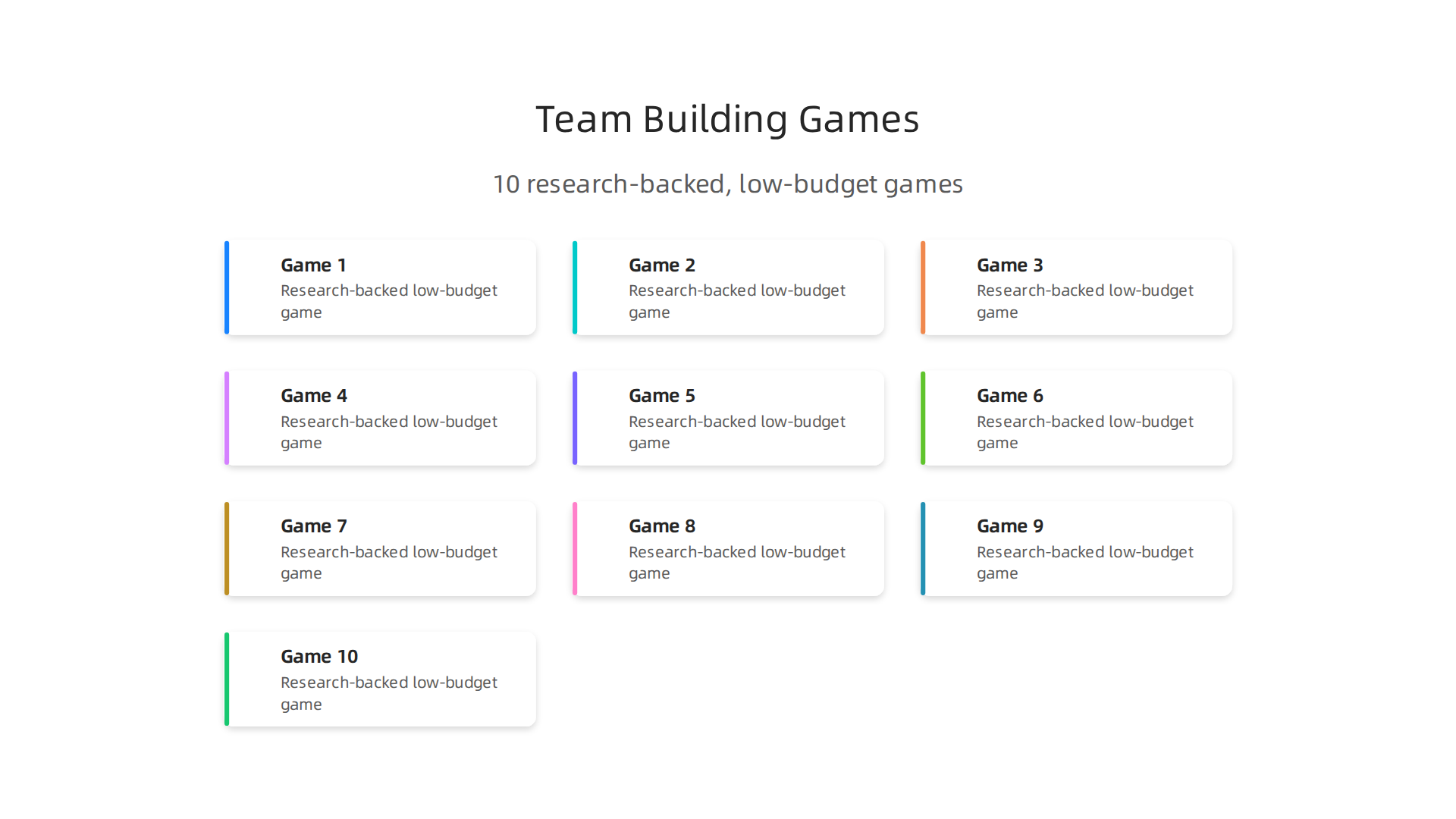
These aren’t cheesy icebreakers nobody wants to do. They are practical, easy to set up, and designed to build real trust. Whether you lead a small group or a whole department, you’ll find ideas that work. And if you want even more examples of team building experience, check out our guide on free online games for team engagement that actually work.
If you are ready to turn your team from distant to connected, start here. Contact us for tailored guidance to boost team engagement and collaboration.
1. Two Truths and a Lie (Virtual & In-Person)
Here is a simple truth about teams. We all want to feel known, but sharing feels risky. Two Truths and a Lie removes that risk completely.
The rules could not be easier. Each person shares three statements about themselves. Two are true. One is a lie. The rest of the team guesses the lie.
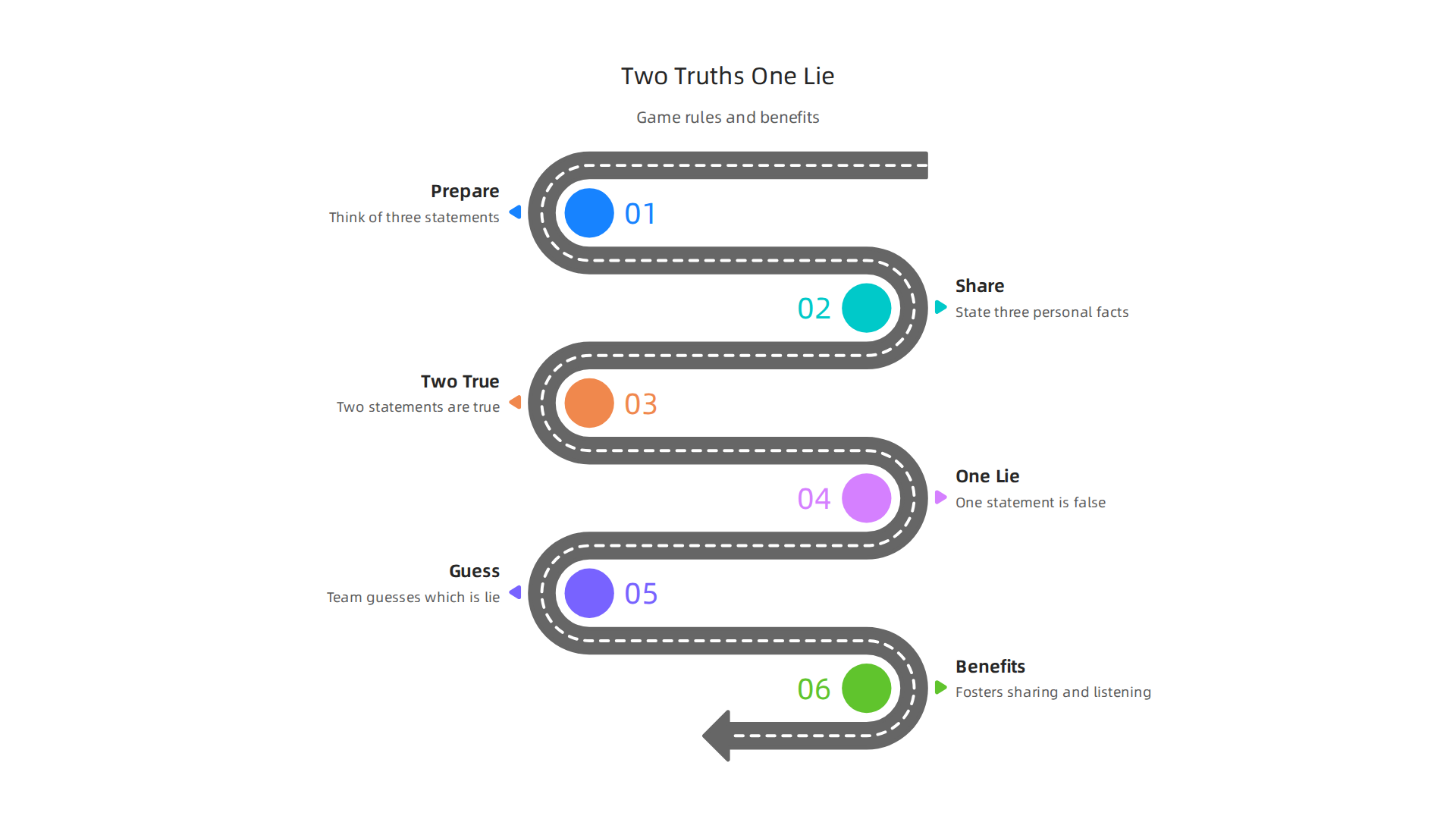
That is it.
Why does this simple format work so well? It encourages personal sharing in a low pressure way. You discover that your quiet coworker once lived in Japan or that your manager was a stand up comedian. These small facts build real connection. The game takes 10 minutes, but the bond lasts much longer.
This game adapts to any setting. In person, gather in a circle. For remote teams, use the chat feature or breakout rooms on Zoom. This flexibility makes it one of the most practical fun group games for any team. Research on virtual team building shows that games promoting active listening improve overall team communication.
The hidden benefit: active listening. When people try to spot the lie, they pay close attention. This skill carries into meetings and daily work. It is one of the best examples of team building experience you can run with zero cost and zero prep.
Pro tip for managers: Take notes during the game. Remember the interesting facts people share. Use them in later conversations or team shout outs. This small habit shows you care, and it deepens the bond.
Want more quick fun games to play with your team? Browse our collection of virtual team bonding activities that build trust without expensive retreats.
If your team is ready for a fresh start and better connection, contact us for tailored guidance on boosting team engagement and collaboration.
2. The Marshmallow Challenge (In-Person & Hybrid)
Now let us talk about a game that turns your team into builders, problem solvers, and fast learners. The Marshmallow Challenge is one of the best fun group games you can try, and it is incredibly simple to set up.
Here is the idea. Your team gets 20 sticks of spaghetti, one yard of tape, one yard of string, and one marshmallow. The goal? Build the tallest freestanding structure you can in just 18 minutes.

The marshmallow must sit on top. No other supports allowed.
This sounds easy, but teams almost always hit a wall. The structure wobbles. The spaghetti breaks. The clock runs out. And that is exactly the point. The Marshmallow Challenge teaches you to prototype quickly, test early, and share leadership under pressure. It forces good team work because no one person can do it alone.
This game is a great example of team building experience that feels fun but delivers real lessons. Tom Wujec, who created the challenge, calls it a powerful design exercise. It shows teams how to collaborate and learn from failure. You will need a stopwatch and a measuring tape, as noted in facilitator guides. But that is all.
Here is the hidden win. The top performing teams are not the ones with the best plan. They are the ones that build a small version first, test it, and adjust. That lesson applies directly to how you work every day. It is one of the most useful fun games to play for hybrid teams because each subgroup can run its own challenge and then compare results.
Want more good team building games you can run with everyday supplies? Check out our list of free online games for team engagement that actually work. And if you need help picking the right activity for your specific team size or setting, contact us for tailored guidance.
- Virtual Escape Room (Remote Teams)
The Marshmallow Challenge is a blast for in person groups, but what about your team members who work from home? For them, a virtual escape room might be the perfect fit.
Here is the setup. Your team logs into a shared digital platform where they are "locked" in a virtual room. They must work together to find clues, solve puzzles, and complete a challenge before time runs out. Each person brings a different skill. One person spots a hidden detail. Another solves a riddle. Someone else remembers a key code. The team must delegate and communicate clearly to escape.
This is one of the best fun games to play for remote groups because it boosts collaboration and problem solving without requiring anyone to leave their home office. According to a guide from Wellhub, virtual escape rooms help build team morale and sharpen communication for distributed teams. The best part is that many good team building games like this one are available as low cost or even free online templates. You can find ready made puzzles on several popular platforms in 2026.
This example of team building experience works especially well for teams spread across different time zones. Since the game runs on a set timer, everyone shows up ready to play together. The shared mission creates natural conversation and laughter. It even helps quieter team members step up and contribute.
Want more ideas for engaging your remote crew? Check out our list of free online games for team engagement that actually work. And if you need help picking the right activity for your specific team size or setting, contact us for tailored guidance.
4. The Blind Drawing Game (All Settings)
Virtual escape rooms are a blast. But sometimes you want something even simpler. Something that shows you exactly where your team’s communication breaks down. That is where the Blind Drawing Game comes in.
Here is how it works. One person gets a simple picture. They must describe it to their partner using only words. The partner, who cannot see the image, tries to draw it based on those instructions.
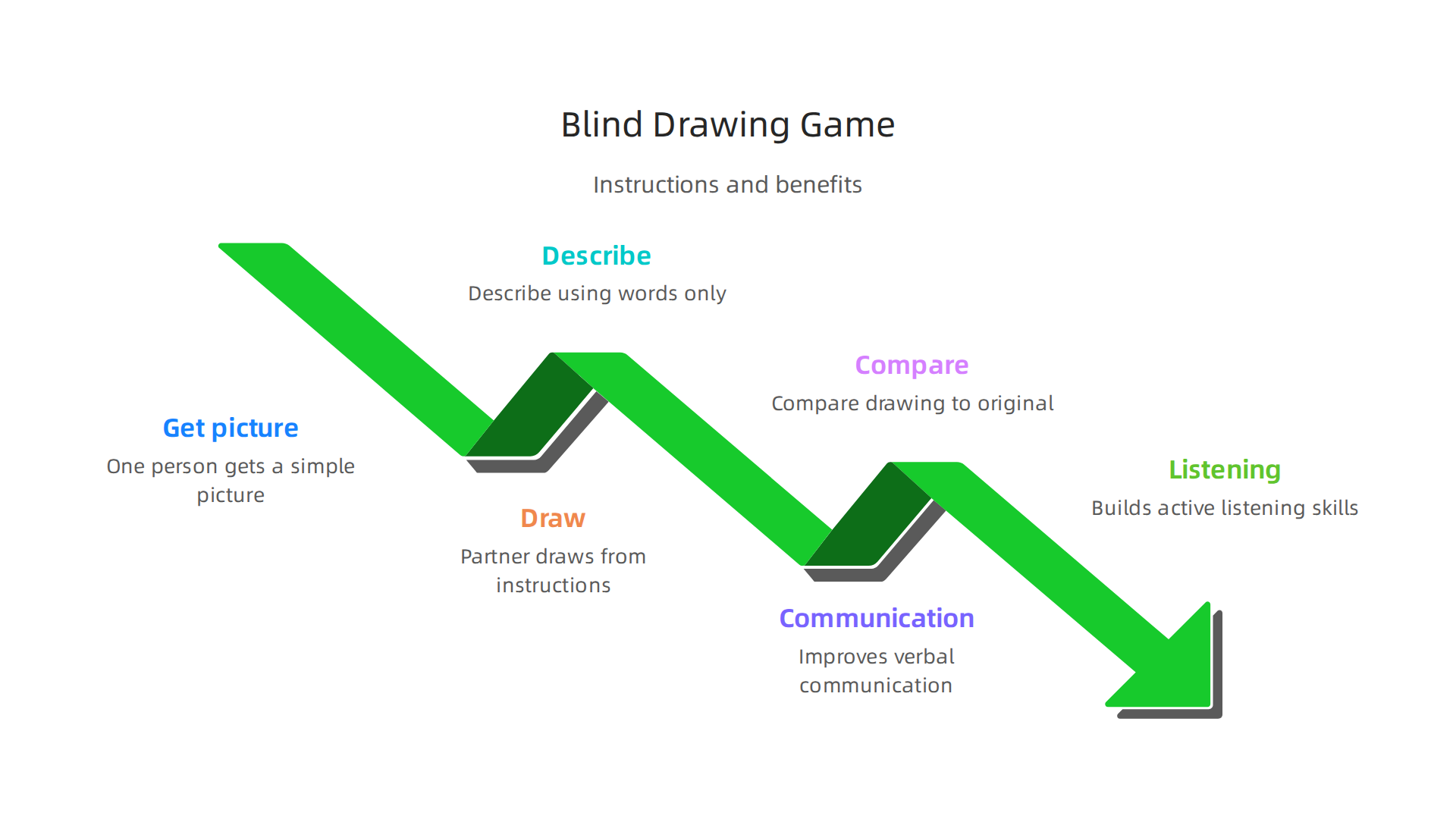
No pointing. No hand gestures. Just words.
It sounds easy. It is not.
Most teams discover pretty fast that giving clear instructions is a real skill. So is asking the right questions. This is one of those fun group games that does two things at once. It creates laughs and reveals communication gaps. The team learns to slow down and choose their words with care. According to a guide on workplace communication exercises from Positive Psychology, activities like this one help teams improve collaboration and reduce misunderstandings.
A resource from Asana on active listening also points out that practicing these skills can boost productivity and cut down on confusion. This activity costs nothing. You just need paper and pens. It works in person or over a video call with a shared screen.
For teams that want to build trust without fancy equipment, this is one of the best fun games to play. It is a top pick among good team building games because the lesson sticks. People remember the moment they realized their description made no sense. Next time, they try harder to be clear.
This simple example of team building experience can also help a new team find its rhythm. It levels the playing field. No one needs to be an artist to win. You just need to listen and speak clearly.
Looking for more low cost ideas that actually build team work? Check out our list of virtual team bonding activities that build trust without expensive retreats. And if you want help picking the right activity for your group, contact us for tailored guidance.
5. ‘Yes, And…’ Story Building (Improv for Teams)
The Blind Drawing Game shows how easy it is to misunderstand each other. Now let’s flip the script. Instead of finding gaps, we build something together.
This game comes from improv theater. The only rule is the "Yes, And" rule. One person starts a simple story. "A penguin walks into a coffee shop." The next person must accept that and add something new. "Yes, and the penguin orders a hot chocolate with extra marshmallows." The story grows one line at a time.
No props needed. You can play in person or on a video call. The goal is not to be funny. The goal is to say yes and keep the story moving. This builds spontaneity and active listening. It also teaches empathy. You have to understand where the last person was going so you can support that idea.
These simple fun group games do something powerful. They lower the fear of being wrong. According to a guide on improv and workplace culture from And Also Improv, activities like this build psychological safety by strengthening listening, trust, and collaboration. Another source from PowerProv explains that corporate improv workshops help teams communicate more openly.
When your team practices saying "yes and" to each other, the culture shifts. It moves away from competition and toward cooperation. People stop worrying about looking silly. They start thinking about how to make the group idea better.
This is one of the best good team building games for a new team or a stuck team. It is also a strong example of team building experience that costs nothing and takes ten minutes. Want more ideas like this that work for remote groups? Check out our list of virtual team bonding activities that build trust without expensive retreats.
If your team enjoys the creative energy of this game, try sharing a light story as a group. Explore the Ridiculous series for funny prompts and quotes that can spark easy conversation.
6. Team Scavenger Hunt (In-Person & Hybrid)
The "Yes, And" game kept you seated and thinking. Now it’s time to get up and move. A team scavenger hunt is one of the most fun group games because it mixes physical activity with teamwork.

You don’t need fancy supplies. Just a list of items to find, photos to take, or silly tasks to complete.
The beauty of a scavenger hunt is its flexibility. You can theme it around company values, learning goals, or seasonal holidays. For example, have teams snap a picture of “something that represents collaboration” or find “an object that starts with the first letter of your project name.” It’s also highly scalable. A group of five or a department of fifty can play together by splitting into smaller squads.
Getting people out of their usual work context sparks fresh energy. It forces teams to communicate quickly and solve problems together. This is a great example of team building experience that doesn’t require expensive retreats or long planning.
Want more good team building games that work for remote or hybrid setups? Check out our collection of virtual team bonding activities that build trust without expensive retreats. You’ll find ideas that keep your team work strong no matter where everyone sits.
If you want to give your scavenger hunt a humorous twist, use funny prompts that create laughter. The Ridiculous series offers playful story ideas and quotes that can inspire your hunt clues. After the hunt, gather the team to share the funniest finds. It’s a simple way to wrap up with smiles.
7. Cross-Functional Bingo (Knowledge Sharing)
The scavenger hunt got everyone moving. Now let’s get everyone talking. Cross-Functional Bingo is a simple but powerful fun group game. It turns ordinary networking into a structured activity where colleagues actually learn from each other.
Here is how it works. You create bingo cards. Instead of numbers, each square has a prompt. For example, “Has worked in customer support,” “Knows how to read a balance sheet,” or “Can name our CEO’s first pet.” The goal is to walk around, talk to people outside your usual team, and find someone who matches the square. They sign your card.
Learning about other roles directly from coworkers breaks down walls. It builds real understanding across departments. This is one of the best examples of team building experience because it mixes open conversation with a clear goal. According to research on structured communication exercises, games like this build a foundation for better collaboration and reduce misunderstandings.
You can customize the squares for your group. Use fun facts, job skills, or company history. This makes it a perfect good team building game for onboarding new hires or launching a big project. It works for small teams and large departments too. If your company has more than 50 people, silos can form fast. This game directly fights that by encouraging friendly interaction between departments.
Looking for more fun games to play that boost team work? Check out our full list of free online games for team engagement that actually work.
Need help setting up your own bingo game? We have ready-to-use templates and guides. Contact us for a free walkthrough of our activity resources.
8. The Human Knot (In-Person Icebreaker)
After getting everyone talking with bingo, it is time to get physical. The Human Knot is one of those fun group games that sounds simple but actually builds real trust fast.
Here is how it works. You stand in a tight circle. Everyone reaches out and grabs two different hands from people across from them. No grabbing the same person’s second hand. Now you are all connected in a mess. The goal is to untangle into a single circle without anyone letting go.
This is a physical problem-solving activity. You have to twist, duck, and step over arms. It teaches patience and collective strategy because one person cannot solve it alone. Everyone must communicate with their bodies and a few words. According to research on trust-building activities, exercises like this directly improve workplace relationships and nonverbal communication.
This good team building game works best for teams of 8 to 12 people. Any larger and it gets too hard to manage. It needs no materials or setup. You just need a little open floor space. It also works great as a quick icebreaker for a new project or a team that just added new members.
If you want more fun games to play that need zero supplies, check out our guide to virtual team bonding activities that build trust without expensive retreats. It has ideas that work whether you are in the office or remote.
Need help planning your next team session? Contact us for ready-to-use activity guides.
9. Lightning Decision Jam (Remote & In-Person)
After the physical challenge of the Human Knot, let us turn to a structured game that speeds up decision making. Lightning Decision Jam is one of those fun group games that actually gets real work done. It combines brainstorming and prioritization into fast, time-boxed rounds.
Here is the simple setup. You start with a team challenge or problem. Everyone writes down as many ideas as possible in a short timer, say three minutes. Then you share, group similar ideas, and vote on the best ones.
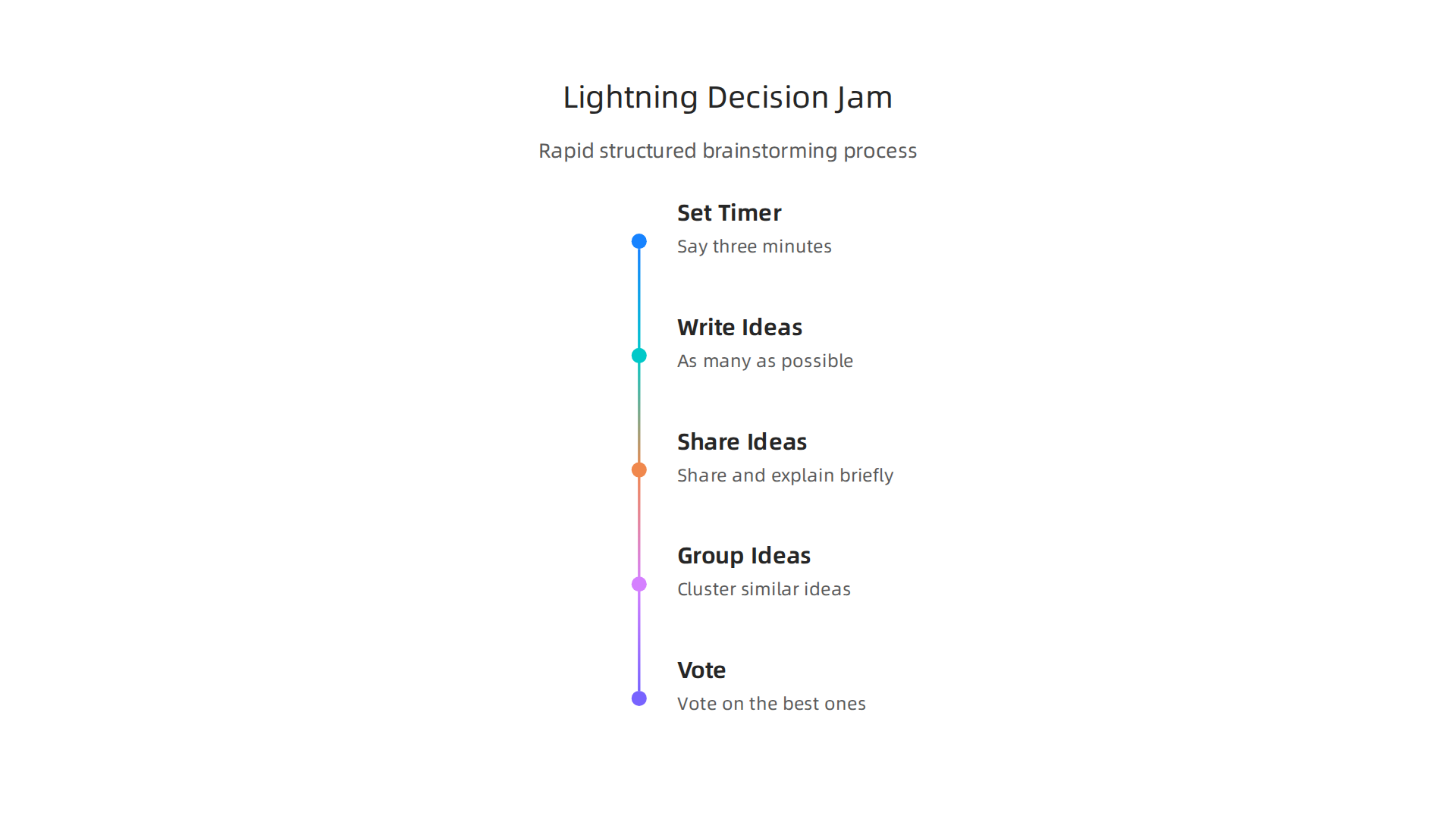
The whole process takes 15 to 20 minutes. The goal is to move from a mess of thoughts to one clear action item.
What makes it such a good team building game is that it forces equal participation. Quiet voices get the same chance as loud ones because writing happens first. According to research from Berkeley Executive Education, psychological safety drives team performance and engagement. Time-boxed games like this one lower the fear of speaking up because everyone shares ideas at once.
This works for both in-person and remote teams. Use sticky notes in the office or a shared digital board online. It is a perfect examples of team building experience that turns a boring meeting into a productive, energetic session. You solve real challenges while building team work skills.
If you want more fun games to play that boost collaboration and decision making, check out our guide to free online games for team engagement that actually work. It has options you can use tomorrow.
Need help tailoring this game for your specific team? Contact us for ready-to-use activity guides and facilitation tips.
10. Show and Tell (Remote-First Tradition)
After the structured chaos of the Lightning Decision Jam, let us slow down. Show and Tell is one of those fun group games that works perfectly for remote teams. The rules are simple. Someone shares a personal item, a hobby, or a story from their life outside work. It takes five minutes. There are no wrong answers.
This is a great example of team building experience because it costs nothing and feels natural. It humanizes your remote coworkers. You see them as people with interesting lives, not just faces on a screen. According to Confetti, simple activities like home office tours help build connection without needing any special materials. It is a good team building game that builds empathy and psychological safety. Sharing a personal story shows vulnerability. When leaders do it first, it gives everyone permission to be real.
To run it, keep turns short and make sharing optional. You will build team work just by listening. For more low-effort ways to connect your distributed team, check out our guide to virtual team bonding activities that build trust without expensive retreats.
For a creative twist, suggest a fun book the team can read and discuss together. Explore the Series for laughs and discussion prompts that make your next Show and Tell session even better.
Summary
This article explains how simple, low-cost group games can significantly improve team engagement, trust, and collaboration both in-person and remotely. It presents 10 practical, research-backed activities—like Two Truths and a Lie, the Marshmallow Challenge, virtual escape rooms, Blind Drawing, and Lightning Decision Jam—that require little preparation but teach listening, clear communication, rapid prototyping, and psychological safety. The piece outlines when and how to run each game, what problems each activity addresses, and easy adaptations for hybrid or distributed teams. Readers will learn which games fit their team size and setting, how to run them with minimal supplies, and how to use play to surface and fix real workplace issues. The article also highlights hidden benefits of each exercise and offers facilitation tips to make outcomes stick. By following these examples, leaders and team members can start using playful activities to break down silos, boost morale, and create more productive meetings without expensive retreats. Contact options and links to deeper collections are provided for teams that want tailored guidance.