

Introduction: Why Virtual Team Bonding Is Non-Negotiable in 2026
You know that feeling. You log into your video call, say your quick hellos, and jump straight into work. No water cooler chat. No random laugh with a coworker. By the end of the day, you feel like you talked at people, not with them.

This is the reality for millions of remote and hybrid workers in 2026. And it is taking a real toll.
Here is what the data shows. Only 31% of fully remote workers report being engaged at work, according to Gable’s 2026 trends report.

That number drops to 19% for on-site workers. Globally, just 20% of employees are engaged, costing the world economy a staggering $10 trillion in lost productivity each year, per Gallup’s latest report.

With 27% of employees working fully remote and another 52% in hybrid setups, as noted in Breeze.pm’s research, we are talking about a huge portion of the workforce feeling disconnected.
Many companies try to fix this with big, expensive events. A fancy offsite. A once-a-year party. But here is the thing. Those one-off efforts rarely work. They cost a lot. They pull people away from their real work. And they do nothing for the day-to-day loneliness your team feels on a Tuesday morning.
That is why this article is different.
We have gathered practical, evidence-based ideas that actually work in 2026. These are not expensive retreat plans. They are simple, low-cost strategies you can use this week. Things like 10 minute team building activities that fit right into your existing meetings. Ways to improve teamwork online using tools you already have, like Slack for team collaboration. And creative approaches to virtual team bonding activities that make distance feel smaller.
Contact us to explore ready-to-use team-building activities and guides tailored to your team’s needs.
The Remote Engagement Crisis: Why Old Approaches Fail
Let us be honest about something. Many virtual team bonding activities that companies try actually make things worse.
Think about the mandatory Friday happy hour. You are already tired from a long week. The last thing you want is to sit in front of your screen for another hour, pretending to sip a drink while the conversation feels hollow.

Or picture the forced trivia game where four people try to answer questions while everyone else mutes their microphone and multitasks.
These approaches fail for a simple reason. They lack genuine connection.
Here is what the research tells us. Hybrid and remote workers consistently report higher loneliness and lower belonging compared to their in-office peers. The issue goes deeper than not seeing people in person. It is about not feeling safe to speak up, share ideas, or be yourself. That feeling is called psychological safety, and it is the foundation of strong teamwork.
According to a recent study published in Frontiers in Psychology, relationship-oriented behavior directly influences how comfortable employees feel voicing their thoughts. Without that comfort, your team will stay quiet. They will not collaborate. They will not innovate.
The numbers back this up. Workplaces with high psychological safety see a 27% reduction in turnover and a 40% increase in innovation. That is a massive difference. But you cannot get there by forcing people to play bingo on Zoom.
Old approaches treat team bonding like a checklist. Do one activity, check the box, move on. But building psychological safety in virtual teams is an ongoing process, not a single event.

It requires trust. It requires consistency. It requires activities that actually fit how your team works.
The good news? You do not need expensive retreats or complicated programs. Simple, consistent efforts work better. Things like a 10 minute team building activity at the start of a meeting. A quick check-in that encourages genuine sharing. Using tools like Slack for team collaboration to create space for informal conversation.
When you move away from forced fun and toward intentional connection, something shifts. Your team starts to engage differently. They feel seen. They feel heard. And that is when real teamwork online begins.
Ready to move past the old approaches? Contact us to explore ready-to-use team-building activities and guides tailored to your team’s needs.
Designing Virtual Bonding That Builds Trust and Psychological Safety
We have covered what does not work. Forced fun just pushes people away. So what does a better approach look like? Designing virtual team bonding activities that actually build trust comes down to three simple rules.
First, make everything voluntary. This is the hardest rule for most leaders. But think about it. If someone is forced to participate in a bonding exercise, does that feel safe? No. It feels like another work task. True psychological safety starts with choice. A recent study shows that psychological safety emerges when team members first build trust in the leader. Forcing participation breaks that trust before it even has a chance to grow. You also need to respect time zones. If you schedule an activity for 9 AM Eastern, your West Coast or international team members get left out. That sends a clear message. "You matter less." Inclusion means letting people join from their own time zone or skipping without penalty.
Second, start with low stakes and asynchronous sharing. Not everyone is an extrovert. Some people need time to think before they share. Use Slack for team collaboration to create a simple channel where people can post answers when they have a moment. Ask a question like "What is the best book you read this year?" or "Share a photo of your workspace." That is it. No pressure. No camera required. These small interactions build familiarity over time. They work great as a 10 minute team building activity that fits into a regular workday without adding meeting fatigue.
Third, slowly move toward deeper sharing. Once your team feels comfortable with small talk, you can introduce prompts that matter. This is where the real connection happens. Research shows that relationship oriented behavior directly influences how comfortable employees feel voicing their thoughts. So instead of asking "What is your favorite color?," try asking "What is a professional challenge you faced recently?" or "What is one thing you are proud of this month?" These questions build real teamwork online because they invite people to share something real. You can find more practical ideas to foster psychological safety in remote teams to guide this process.
A great way to start this slow deepening is through a shared experience. A funny book, for example, gives everyone an easy topic to talk about. It lowers the barrier for sharing and opens the door to natural conversation. Explore the Series to find a lighthearted story your team can enjoy together. It is a simple step that builds trust one laugh at a time.
Top Virtual Team Bonding Activities for Low Budget and High Impact
So you have the right mindset. You know to keep things voluntary, start slow, and build trust over time. Now comes the fun part. What do you actually do together? Here is the key. The best virtual team bonding activities match your team’s current goal. Do you need more creativity? Better problem solving? Or just a little stress relief? Pick the activity that fits the need, not just the calendar.
For building creativity and connection
When your team seems stuck in routines or low on energy, try something playful that gets people thinking differently. A virtual scavenger hunt works great here. Ask everyone to find something in their home that is blue, something older than them, and something that makes them laugh. Give it 10 minutes. The results are always surprising. As one guide explains, simple activities like scavenger hunts cost nearly nothing to organize yet create real energy. That is a perfect 10 minute team building activity that fits between meetings.
Another favorite is Show and Tell. Everyone picks one object from their desk, fridge, or bookshelf and shares why it matters. It reveals personality without forcing deep conversation. You can launch this in under two minutes. No prep needed.
For strengthening problem solving
Teams that collaborate daily sometimes forget how to think together in new ways. Virtual escape rooms fix that. They push people to communicate clearly and solve puzzles under a time limit. Many online platforms let you run a 30 minute game with zero setup. You can find plenty of ideas for virtual team building activities that include puzzles and creativity competitions to challenge your group.
If you want something even simpler, try a collaborative playlist. Ask each person to add one song that matches a theme like "songs that make you smile." Then listen together during a break. It is low pressure, builds shared culture, and takes five minutes to start.
For boosting wellbeing and reducing stress
Burnout is real in remote teams. Sometimes the best bonding is just being together without any work agenda. Host a virtual co-working sprint. Everyone logs on, works quietly on their own tasks for 25 minutes, then shares one win. That is it. No forced talking. Just presence.
You can also try a walking challenge. Team members compete in steps over a few weeks. As one resource shows, team based walking challenges keep teams engaged over months without meetings or screens. It improves health and connection at the same time.
Quick reference: activities and timing
| Activity | Goal | Setup time | Duration |
|---|---|---|---|
| Virtual scavenger hunt | Creativity, energy | 2 minutes | 10 minutes |
| Show and Tell | Connection, trust | 1 minute | 15 minutes |
| Virtual escape room | Problem solving | 0 minutes | 30 minutes |
| Collaborative playlist | Culture, fun | 3 minutes | Ongoing |
| Co-working sprint | Wellness, focus | 0 minutes | 25 minutes |
One more idea that deserves its own spotlight. A shared book gives everyone something easy to talk about. It creates natural conversation without awkward icebreakers. If you want a light start, explore the series for a funny story your team can read and discuss. It turns a simple read into a real bonding tool. And it works on any budget.
Asynchronous Activities for Global Teams
What if your team is spread across twelve time zones? You cannot force everyone to meet at the same time. That is where asynchronous activities save the day. These are things people do on their own schedule, then share later. No live meetings. No midnight calls.
Shared photo challenges work great here. Pick a weekly theme like "where I work" or "my view today." Everyone snaps a photo and posts it in a shared channel. It gives a peek into each other’s lives without needing to be online together. As one guide notes, simple low cost activities like this create real energy without expensive tools or planning.
Virtual coffee chats through Slack are another winner. Pair up two team members from different time zones. They find a 15 minute window that works for both and hop on a quick video call. No agenda. Just a casual chat. It builds relationships naturally. You can use a bot or a simple spreadsheet to rotate pairings each week.
Quarterly team yearbook is a bit bigger but worth the effort. Collect fun facts, favorite memories, and photos from the past three months. Compile them into a simple document or slideshow. Everyone contributes whenever they have time. It turns into a keepsake that celebrates the team’s unique culture. For more ideas on virtual team building activities that work across time zones, check out the full list of options.
One more idea that fits the asynchronous mold is a shared book. People read a chapter on their own time, then drop thoughts into a chat thread. It creates natural conversation without forcing a meeting. If you want a light, funny start, Read Book 1 from a quirky sci-fi comedy series. It gives everyone something to talk about without pressure.
Synchronous Activities That Energize Meetings
Does your team have a recurring meeting that feels flat or boring? You can fix that in under ten minutes.
Use the first 5 to 10 minutes of your regular calls for a quick bonding ritual. It sets a lighter, more human tone before diving into project updates. These short bursts of fun rank among the most effective virtual team bonding activities because they are simple and repeatable.
Two Truths and a Lie
This classic never fails. One person shares two true facts and one lie. The team guesses the lie. It is fast, funny, and reveals surprising things about coworkers. According to a roundup of virtual team building activities that work in 2026, this game fits both new and established teams.
Virtual Background Contest
Pick a silly theme like "worst vacation photo" or "celebrity lookalike." Everyone changes their Zoom background to match. Spend the first few minutes admiring the results. You can even post the winning background in Slack for team collaboration to keep the fun going all day. These kinds of simple, low cost activities create real energy without needing expensive tools.
Weekly Wins Share
Go around the virtual room. Each person shares one small victory from the past week. It does not have to be work related. Maybe someone finally fixed a leaky sink. The point is to start the meeting on a positive note. It boosts morale and builds a culture of appreciation. It is one of the best 10 minute team building activities you can try.
These quick rituals make your teamwork online feel more connected. They take almost no planning. But if you want a structured playbook to roll these out across multiple teams, we can help. Contact us to explore ready to use team building guides tailored to your team’s needs.
Integrating Bonding Into Daily Workflows and Rituals
You already know quick games can spark energy. But here is the real secret. Bonding should not feel like a separate event you plan once a month. It works best when you weave it into the regular flow of work.
Think about your project kickoffs, retrospectives, and one on ones. Each of these moments is a chance to build connection. When you treat virtual team bonding activities as part of the daily rhythm, they stop feeling forced. They become part of how your team operates.
Use tools that automate organic connection. Platforms like Donut, Water Cooler, or custom integrations inside Slack for team collaboration can pair people up for casual chats.
These tools remove the awkwardness of scheduling. They simply pop up and ask two teammates to grab a virtual coffee. According to a guide on team rituals for remote teams, small automated prompts help teams stay connected without adding planning time.
Create a team charter together. This is a living document that includes your shared values, communication norms, and expectations. When your team co-creates this charter, you build trust from the start. It also makes teamwork online clearer because everyone knows how to interact. Research on inclusive rituals for remote teams shows that co-created norms help everyone feel included.
Here is how a daily rhythm might look:
- Monday morning kickoff: 5 minute win share
- Wednesday midweek: Automated Donut coffee chat
- Friday close out: Virtual background contest
- Monthly retro: Team charter check in
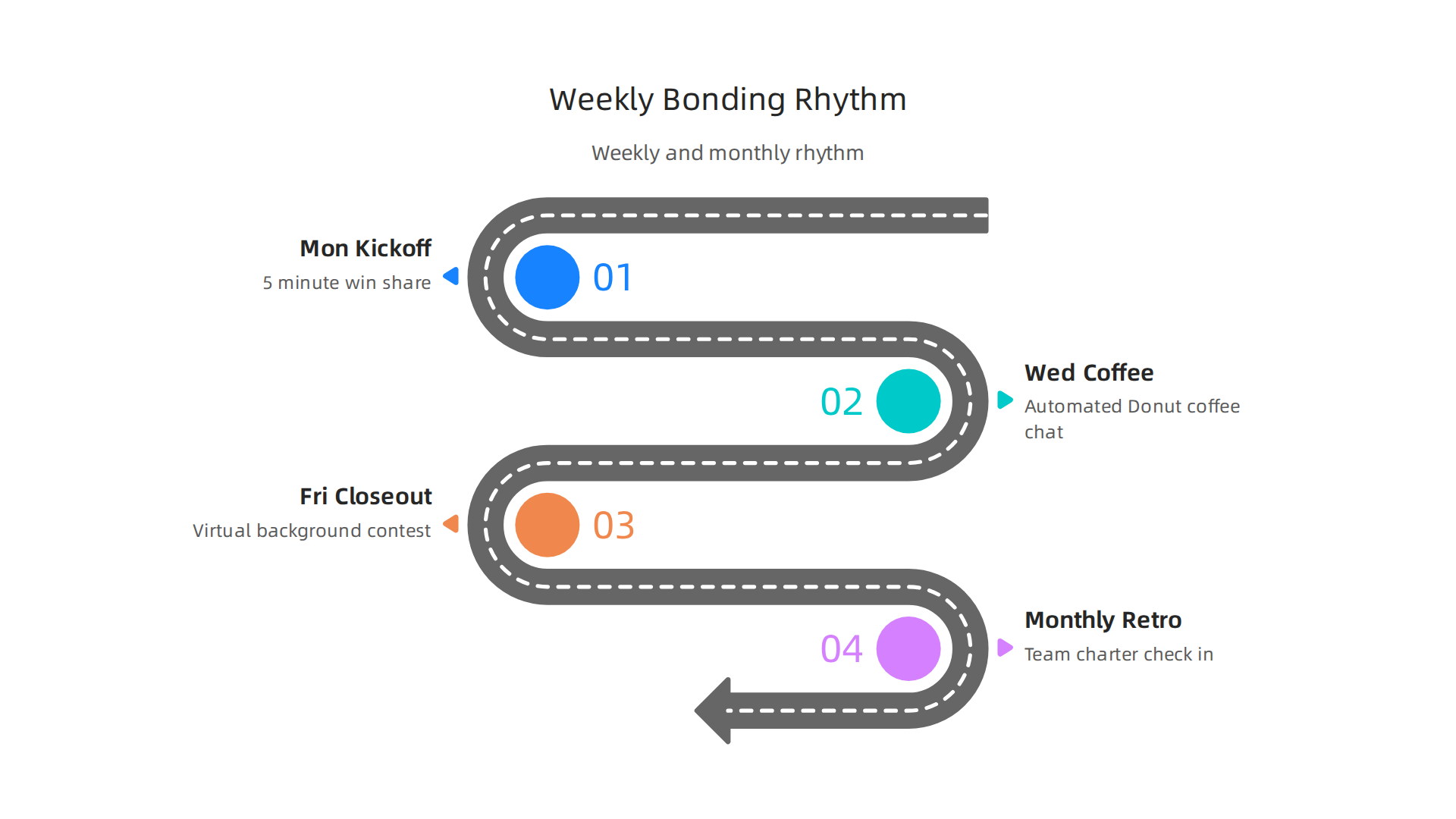
These are simple 10 minute team building activities that fit into your existing calendar. They build repetition without burnout.
The best part? You do not need to design this from scratch. We have done the heavy lifting for you. Contact us to explore ready to use team building templates that fit right into your team’s daily workflow.
Measuring the ROI of Virtual Team Bonding
So you have woven more connection into your team’s week. How do you know it is actually working? Leaders often ask this question before they invest time or budget into virtual team bonding activities. The good news is you can measure the impact without a complicated system.
The simplest place to start is with pulse surveys. Tools like eNPS (employee Net Promoter Score) or a belonging score give you a clear before and after picture. You run a short survey before you start any new bonding activities. Then you run the same survey a few weeks or months later. Research shows that organizations using this approach have seen an average 30% increase in teamwork metrics over six months. That is a real number you can take to your boss.
You should also track a few other simple numbers. Participation rates tell you if people actually want to join. Retention rates show if your teamwork online efforts help keep people around longer. And do not ignore qualitative feedback. A quick "How did that feel?" after a session can reveal more than any spreadsheet.
Here is a simple scorecard you can build:
- Belonging score from your team survey
- Participation rate in weekly bonding activities
- Number of after work or cross functional chats per month
- Project delivery speed before and after bonding routines
- Retention rate for the team over six months
The real magic happens when you tie these numbers to business outcomes. Do projects ship faster? Are teams coming up with more creative ideas? Studies on measuring the ROI of team building activities show that collaboration improvements directly affect innovation and speed. When people trust each other, they take smarter risks and solve problems faster.
You do not need a data science degree to make this work. Start with one survey. Track one participation number. Collect one story from a team member. That small amount of proof can unlock real support for your bonding efforts.
We can help you build a simple measurement plan that fits your team’s size and goals. Contact us to get our free ROI tracking template designed specifically for remote and hybrid teams.
Overcoming Common Barriers: Time, Budget, and Participation
You know virtual team bonding activities can boost engagement. But let’s be real. You might be thinking, "I don’t have time for this." Or "My budget is zero." Or your team is already tired of another forced fun event. These barriers are real, but they are not roadblocks. You just need a smarter approach.
The number one barrier managers report is lack of time. You are busy. Your team is busy. The fix is simple: keep it short. You do not need a two hour workshop. You need 10 minute team building activities that fit into existing meetings. Try a quick check in like "What was your win this week?" or a fast brain teaser. Even five minutes of structured connection can shift the energy. Research shows that remote workers who feel engaged often have consistent, short touchpoints. When you make bonding micro instead of massive, participation stays high.
Budget is the next big worry. But here is the truth. Many of the best bonding tools are free or very low cost. Digital platforms like Slack (great for Slack for team collaboration) let you add fun channels, polls, or quick games without spending a dime. You can run a team quiz using free tools. You can share a one question survey about who would survive a zombie apocalypse. The cost is your creativity. And that is unlimited.
Then there is participation fatigue. If your team groans when they see another "bonding" calendar invite, you have a trust problem. The solution is choice and rotation. Do not force everyone into the same activity. Let team members pick from a list of options. Rotate who leads the session. When people have ownership, they show up differently. One week might be a story sharing game. The next could be a quick problem solving challenge. Give them a voice, and fatigue drops.
You already have what you need to start. And if you want a ready to use guide that walks you through these barriers step by step, we have you covered.
Contact Us to get our free barrier busting toolkit for remote teams.
Tailoring Strategies for Different Team Sizes and Cultures
Once you clear the common barriers, the next question is always the same. "What works for my specific team?" Here is the honest answer. It depends. A team of three needs something totally different from a department of 30. And a team spread across five countries needs something different from a team in one time zone. So do not grab a random activity off a list. Pick one that fits your team’s size and culture.
Small teams of 2 to 5 people have a real advantage. You can go deeper. You can ask personal questions. You can share stories that build real trust. A quick check in like "What is something you learned this month?" works great. These virtual team building activities for small groups often feel more like real conversations. And that is the goal. You want connection, not performance.
Large teams of 10 or more need a different structure. If you put 20 people in one room, only a few will speak. The fix is breakout rooms. Split into groups of 3 or 4 for 10 minutes. Let them do a fast icebreaker or a short problem. Then come back and share. This keeps everyone involved. Research shows that remote workers feel more connected when they interact in smaller, consistent groups.
Cross-departmental bonding is a different beast. When people do not work together daily, generic activities feel irrelevant. So make the content matter to everyone. Try a shared experience like reading a funny book and talking about it. It gives people something to discuss that is not about work. You can Read Book 1 to give the group a light, easy starting point.
Cultural sensitivity matters more than you think. Not everyone loves loud games or personal sharing. Adjust for introverts and extroverts. Offer quiet options like chat based questions. Respect different cultural norms around hierarchy and humor. When you make everyone feel safe, participation goes up naturally.
Still unsure where to start for your specific team? Contact Us to get a personalized recommendation that fits your size and culture.
Future Trends: AI, VR, and the Next Wave of Virtual Connection
So what is coming next for virtual team bonding activities? The tools are getting smarter. And the experience is about to feel a whole lot more real.
AI powered matchmaking is already here. Imagine a system that pairs people not by their job titles but by their actual interests. AI can look at what team members talk about in Slack for team collaboration, check their hobbies, and match them into buddy systems or interest groups. This turns random pairings into real connections. No more awkward "so what do you do" conversations. Instead, you get meaningful chats from day one.
VR meeting spaces are becoming more accessible too. In 2026, businesses are already using virtual reality for training and simulation. Social VR platforms now let teams meet, collaborate, and share events inside shared virtual spaces. Tools like Meta Horizon Workrooms let you put on a headset and feel like you are in the same room with your team. It is not just a video call anymore. It is a shared space where you can read body language, see gestures, and actually feel present.
Gamification and personalization will drive deeper engagement. Instead of one size fits all activities, future tools will adapt to your team. They will recommend 10 minute team building activities that fit your team’s energy level and personality mix. Some people love competition. Others prefer quiet collaboration. Smart systems will adjust automatically.
The result? Teamwork online will feel less like a chore and more like a genuine experience. You will not just check a box. You will build bonds that last.
Want to get ahead of these trends without waiting for the technology? Start with a shared experience today. Something as simple as reading a funny book together can create the same kind of connection. Explore the Series for a light, easy starting point that brings your team together through laughter.
Summary
This article explains why virtual team bonding is essential for remote and hybrid teams and gives practical, low-cost strategies you can use right away. It covers why one-off events fail, how psychological safety drives engagement, and three design rules—make activities voluntary, start with low-stakes asynchronous sharing, then deepen conversations. You’ll find concrete activity ideas for creativity, problem solving, wellbeing, asynchronous global participation, and quick meeting rituals, plus guidance on integrating bonding into daily workflows. The piece also shows how to measure impact with simple pulse surveys and participation metrics, overcome common barriers like time and budget, and tailor approaches by team size and culture so you can start building real connection this week.