

Introduction
Let’s be honest. If you’ve read one resume that calls someone a "team player," you’ve read a thousand. That phrase has become a resume cliché. It barely means anything anymore. When everyone calls themselves a team player, the word loses its power.
So what does it really mean to work well with others in 2026? The truth is, hiring managers and HR professionals struggle to put their finger on what collaborative qualities actually look like.

And candidates? They water down their impact by using the same tired term over and over. According to LanguageTool, there are many better ways to describe teamwork skills, like "team-oriented" or "supportive team member."
But most people stick with the safe, boring option.
Here’s the thing. The English language is full of rich, specific words that capture what real collaboration looks like. Words like "collaborative professional," "cross-functional contributor," and "partnership-focused individual" tell a much clearer story. They show you understand what makes teamwork tick. A quick look at Merriam-Webster’s thesaurus reveals dozens of related terms like "crew," "squad," and "company" that can add variety to your vocabulary.
This guide explores a wide range of synonyms of team player and how to use them in the right context. We’ll also look at the behavioral science behind effective collaboration. The goal is simple: help you communicate and evaluate teamwork with real precision. Whether you are writing a resume, conducting interviews, or building a strong culture, knowing the right team players synonym makes a difference.
Ready to move past the generic label and discover the team synonym options that actually impress? Want to tap into the spirit team energy of a team genius? Let’s get started. And if you want practical ways to build these skills, check out these proven tips on how a team leader makes team building programs actually work.
Top 10 Synonyms for ‘Team Player’ You Should Know
You already know phrases like "collaborative professional" and "team-oriented" beat the boring old phrase "team player." But did you know there is a perfect team players synonym for every single work situation? Whether you need a word for a sales resume or a way to describe a team genius on a performance review, the right term makes people stop and listen. Your spirit team members bring the energy. Your "bridge-builders" fix conflict before it spreads. Here is the definitive list of synonyms of team player you need in 2026.
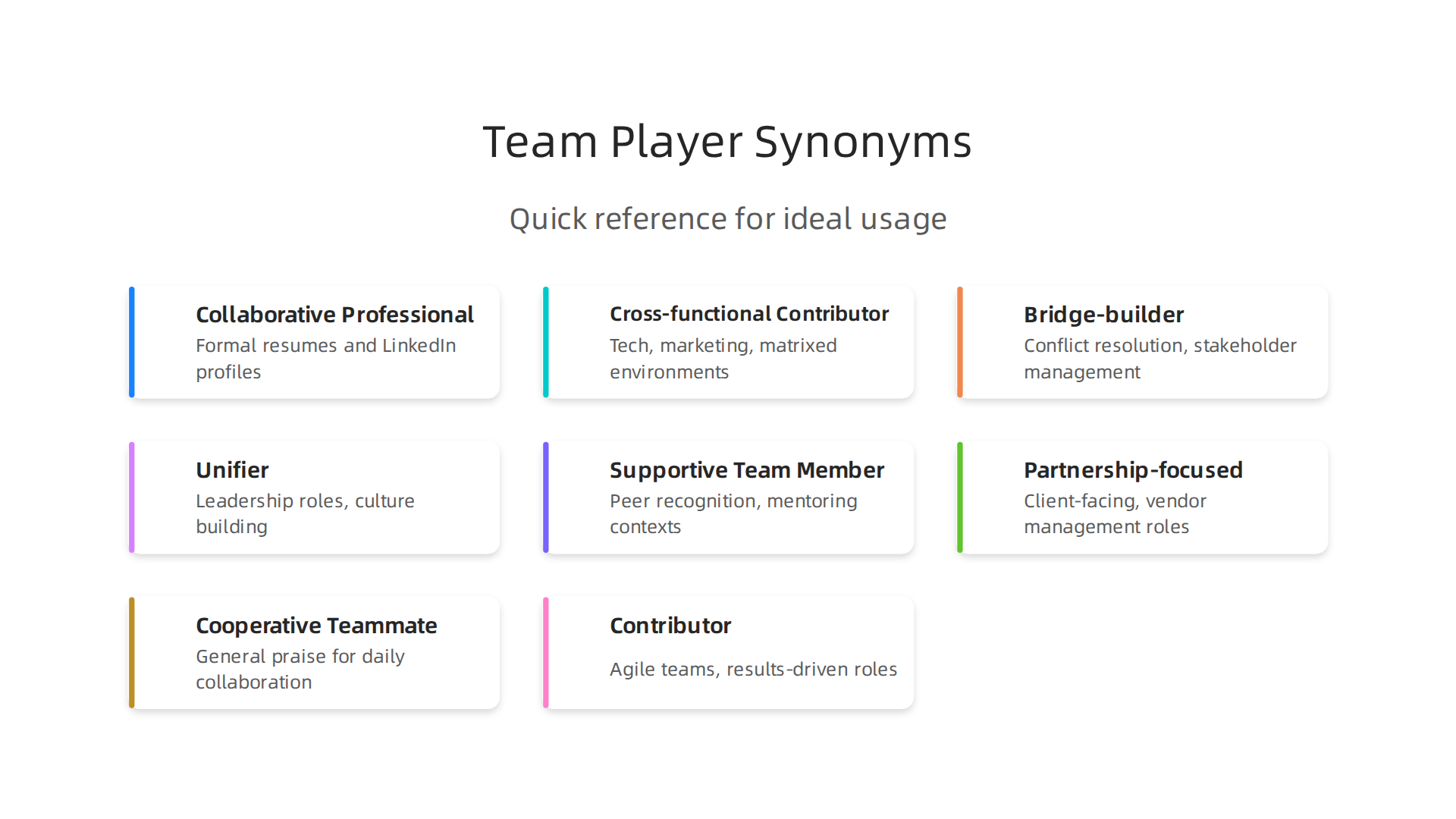
A Quick Reference Table
| Synonym | Best Used For | Example on a Resume or Review |
|---|---|---|
| Collaborative Professional | Formal resumes and LinkedIn profiles | "A collaborative professional who consistently drives project success." |
| Cross-functional Contributor | Tech, marketing, or matrixed environments | "Skilled cross-functional contributor bridging engineering and product goals." |
| Bridge-builder | Conflict resolution and stakeholder management | "Natural bridge-builder who aligns diverse team objectives." |
| Unifier | Leadership roles and culture building | "A trusted unifier who strengthens team morale and shared purpose." |
| Supportive Team Member | Peer recognition and mentoring contexts | "A supportive team member who actively elevates junior colleagues." |
| Partnership-focused | Client-facing or vendor management roles | "Partnership-focused individual trusted by key external stakeholders." |
| Cooperative Teammate | General praise for daily collaboration | "A cooperative teammate who ensures smooth daily operations." |
| Contributor | Agile teams and results-driven roles | "Top contributor in sprint planning and feature delivery." |
| Collaborator | Creative, research, or strategic projects | "A creative collaborator who brainstorms and executes bold solutions." |
| Team Genius | High-performing, innovative work groups | "Recognized as a team genius for groundbreaking problem-solving." |
Which Synonym Fits Your Context?
Think about what you actually do at work. Do you work across departments? Then cross-functional contributor is your best bet. This term shows you can handle complex, modern workflows. According to experts at Synonynms.com, this is one of the top professional alternatives to "team player."
Do you bring people together when things get tense? You are a bridge-builder. According to SHRM, unlocking an organization’s full potential often means creating a space where these bridge-builders feel empowered to step up.
They are the glue that holds teams together through hard changes.
If your strength is helping others succeed, supportive team member works well. LanguageTool lists it as one of the most effective alternatives for a strong resume.
Go Deeper with Actionable Tools
The word "team" itself has great team synonym options. Words like "crew," "squad," and "company" from the Merriam-Webster thesaurus can add variety to your everyday language. The Thesaurus.com page also lists simple alternatives like "associate" and "teammate."
But here is the real secret. The power is not just in knowing the word. It is in matching the synonym to the actual behavior you witnessed. If someone always helps the group reach a final decision, call them a unifier. If they are the go-to person for getting the job done, call them a contributor.
How do you spot these behaviors? And how do you build them in your own team? You start by practicing new ways to communicate and collaborate. Working on specific design principles for team collaboration helps you move from just saying the right word to truly being the right teammate.
Pick one synonym from the table today. Write it into your resume draft or your next feedback note. Watch how much clearer the message becomes when you stop saying "team player" and start showing exactly what you bring.
Contextual Usage: When to Use Each Term
Knowing the right synonym is only half the battle. The real trick is knowing where to use it. A word that shines in a performance review might fall flat in a job description. And the same team players synonym that works for your LinkedIn profile could sound awkward when you introduce yourself in a meeting.
Let’s break it down by context so you can pick the perfect word every time.
Job Descriptions and Resumes
Hiring managers scan resumes in seconds. They don’t just want to see "team player". They want proof. Use synonyms of team player that show specific skills.
- Collaborative professional works best for formal resumes and cover letters. According to Synonynms.com, this is one of the top professional alternatives because it sounds serious and results-focused.
- Cross-functional contributor is gold for tech, marketing, or project management roles. It tells the reader you can work across departments without hand holding.
- Supportive team member fits well in the "experience" section when you helped others grow. LanguageTool lists this as one of the most effective alternatives for a strong resume.
Performance Reviews and Feedback
Reviews are about recognition. Here you want words that describe behavior, not just personality.
- Bridge-builder calls out conflict resolution. If a colleague always smooths over disagreements, use this.
- Unifier works for leaders who strengthen team culture. SHRM emphasizes that unlocking an organization’s potential means empowering these kind of people.
- Team genius is a bold choice for the person who brings innovative solutions. It works best in high performing teams that already value creativity.
Team Introductions and Daily Language
When you are introducing yourself or a teammate in a meeting, keep it simple and natural.
- Collaborator sounds modern and active. Thesaurus.com groups it with "associate" and "teammate". Use it for creative or strategic projects.
- Cooperative teammate is a safe, warm term for day to day work.
- Contributor works well in agile teams where everyone owns a piece of the work.
Personal Branding on LinkedIn
Your headline and summary should show who you are in one glance.
- Partnership-focused is great if you work with clients or external vendors.
- Cross-functional contributor again shows range.
- Unifier can go in the "about" section if you lead teams.
Expert Tip: Avoid Buzzword Fatigue
Here is the thing. Using the same word over and over makes it lose meaning. A single team synonym like "crew" or "squad" from the Merriam-Webster thesaurus can freshen up your language. But swap it around depending on the audience.
If you are writing three different job applications, do not use "collaborative professional" in all of them. Pick one for the first, "partnership-focused individual" for the second, and "cross-functional contributor" for the third. This keeps your language fresh and shows you understand different workplace cultures.
The best communicators match their team players synonym to the moment.

They know when to be formal, when to be warm, and when to be bold. And they never let a good word get stale from overuse.
Want to practice these skills in real situations? Check out these design principles for team collaboration to build the actual behaviors behind the buzzwords.
The Behavioral Traits Behind a True Team Player
Picking the right word is only the start. The real payoff comes when you understand the behaviors behind it. A team players synonym like "collaborator" sounds great on paper. But what does a collaborator actually do differently every day? Let’s look at the research.
What Makes a Team Work
McKinsey research shows that effective teams depend on high levels of trust and communication.

These aren’t soft skills. They are measurable behaviors. A person who is a true spirit team member (someone who lifts others) does three things consistently:
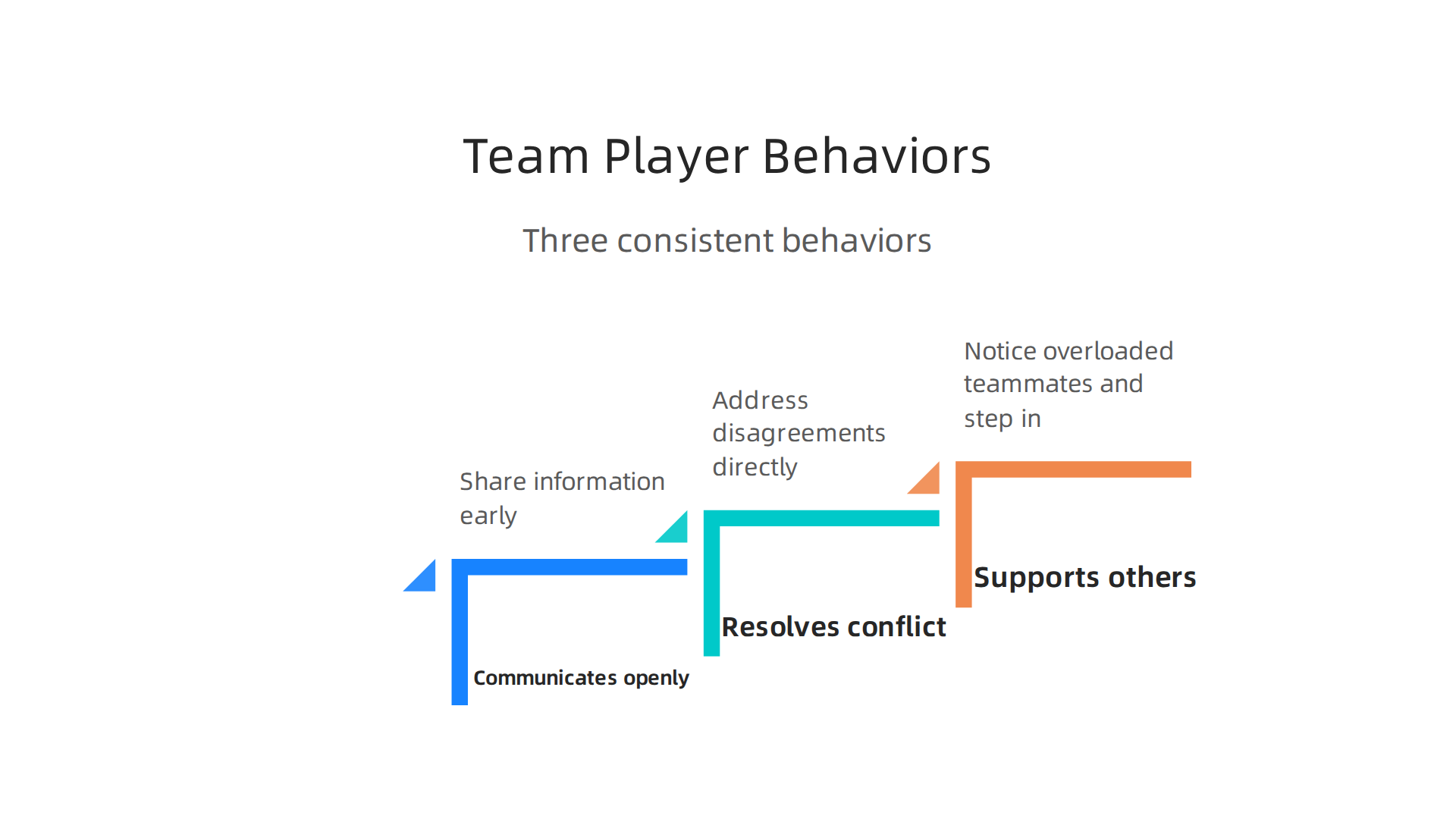
- Communicates openly. They share information early, even when it is uncomfortable.
- Resolves conflict head on. They don’t avoid hard conversations. They address disagreements directly to keep the team moving.
- Supports others without being asked. They notice when a teammate is overloaded and step in.
A study from the NIH on psychological safety in the workplace confirms that when leaders encourage open communication and mutual support, employees feel safer to speak up. That safety is the foundation of high performance.
Mapping Synonyms to Behaviors
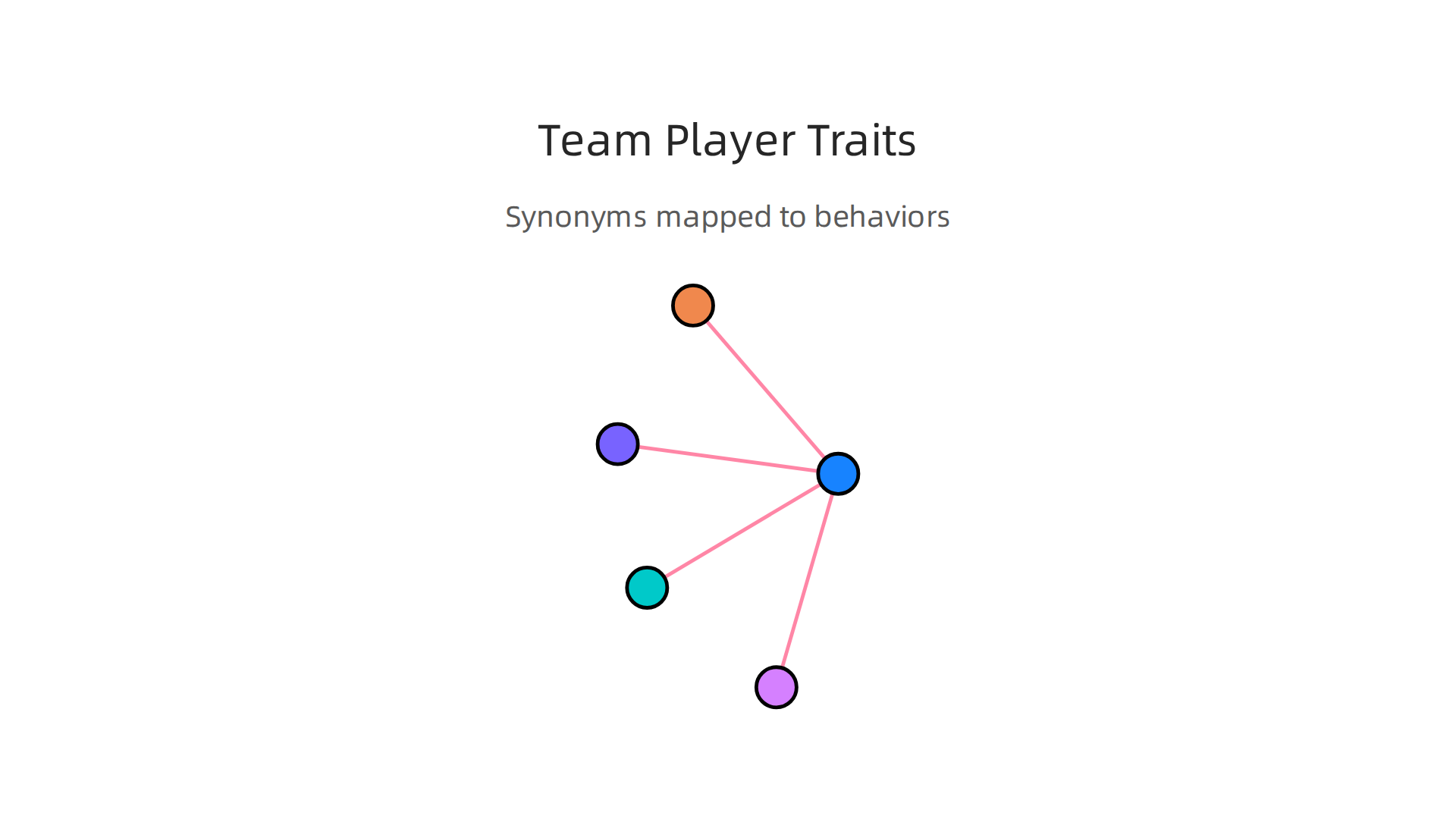
Now here is how specific synonyms of team player connect to actual traits.
| Synonym | Key Behavior | Example |
|---|---|---|
| Collaborator | Shares credit and builds on others’ ideas | In a brainstorming session, they say "Yes, and…" |
| Bridge builder | Resolves conflict between departments or people | They mediate a disagreement without taking sides |
| Reliable teammate | Follows through on every commitment | They meet deadlines and communicate delays early |
| Unifier | Creates a sense of belonging and shared purpose | They organize social check-ins or celebrate team wins |
| Team genius | Brings creative solutions and encourages innovation | They suggest a new process that saves time for everyone |
These behaviors are what employers look for in behavioral interviews. According to Workable’s interview question guide, common questions include "Describe a time you handled a disagreement on a team" or "Tell me about a project where you had to support a struggling colleague." Interviewers use these questions to see if you have actually done these things, not just claimed you are a team players synonym.
Why Behavior Beats Buzzwords
Here is the thing. You can call yourself a "cross-functional contributor" all day. But if you have never worked across departments or solved a conflict, the label is empty. That is why structured interviews, like those recommended by the U.S. Office of Personnel Management (OPM), focus on past behavior as the best predictor of future performance.
The best communicators don’t just drop a team synonym into their resume. They back it up with stories that show reliability, adaptability, and generosity. For example, instead of saying "I am a supportive team member," they might say "I volunteered to cover for a teammate who was sick and helped the team hit our deadline."
How to Develop These Behaviors
You don’t have to be born with these traits. You can practice them. One of the best ways is through structured team activities that build trust and communication. Playing a simple game or doing a short icebreaker can train your brain to be more collaborative. Check out this guide to build a dream team with practical team building questions and activities to start strengthening your real world skills today.
The bottom line: choose your synonyms of team player carefully. But invest even more in the behaviors that make those words true.
Why Language Matters: The Impact of Team Terminology on Culture
You now know that behaviors matter more than buzzwords. But here is something just as important. The actual words you use to describe teamwork shape your company culture every single day. Research backs this up. According to the 2026 State of the Global Workplace Report, how employees feel about their work environment directly predicts organizational resilience and performance. And a big part of that feeling comes from the language leaders and teammates use.
How Precise Language Boosts Engagement
When you use vague labels like "good team player," you miss a chance to reinforce specific behaviors. But when you get precise, something shifts. The Perceptyx 2025 benchmark data shows that highly engaged employees are more than 2.5 times as likely to believe their organization recognizes and values their contributions. Strategic recognition, as highlighted in the Bersin study by Reward Gateway, marries human needs with business goals. Using clear, inclusive terms like "collaborator" or "bridge builder" is a form of recognition. It tells people exactly what you appreciate about them. That clarity drives engagement.
Case Study: A Company That Changed Its Words
Take a mid-size tech firm with 500 employees. They had high turnover and low engagement scores. Their performance reviews used generic phrases like "shows team spirit" and "is a team player." No one knew what those meant. So they redesigned their review language.
Instead of "team player," they used specific synonyms of team player tied to observable behaviors:
- "Collaborator" meant they actively built on others’ ideas.
- "Reliable teammate" meant they followed through on commitments.
- "Unifier" meant they helped resolve conflicts.
Within one year, the company saw a measurable improvement in retention. The Work Institute 2026 Retention Report confirms that asking the right questions and using precise language in feedback drives higher retention. Employees felt seen and understood. The vague "team players synonym" was replaced with words that had actions behind them.
The Real Risk of Generic Terms
Here is the danger. The term "team player" can actually hide performance gaps. Someone might look like a team player because they are agreeable and never cause trouble. But are they truly collaborating? Are they resolving conflicts? The Employee Engagement in the Digital Age study from Liberty University notes that representation and clear communication are key drivers of an engaged workforce. When you use fuzzy language, you allow fuzzy performance to slide.
On the flip side, using precise team synonym terms like "spirit team" or "team genius" forces real conversations. It sets a higher bar. A "team genius" is someone who brings creative solutions and encourages innovation. That is a much higher standard than just "being nice." The 2026 Human Resources Strategic Plan from Lancaster County emphasizes inclusive hiring practices and talent development. Precise language is a core part of inclusivity. It makes expectations clear for everyone.
Building a Culture Through Words
The language you choose shapes the culture you get. When you replace generic praise with specific recognition, you tell your team what excellence looks like. You can reinforce this culture with structured activities that practice the behaviors behind the words. For example, using design principles for team collaboration that actually fix communication problems can help translate precise language into daily habits.
So next time you write a review or give feedback, skip "good team player." Use one of the synonyms of team player that actually describes what you saw. Your team will feel it. And your culture will be stronger for it.
Using Team Player Synonyms in Resumes and Performance Reviews
Now that you understand how precise language changes culture, let’s talk about where it matters most: your resume and performance reviews. Whether you’re a job seeker trying to stand out or a manager giving feedback, swapping out "team player" for something specific makes a massive difference. Recruiters in 2026 are tired of clichés. According to a career expert roundup, vague buzzwords like "team player" are at the top of the "hate" list because they don’t prove anything. You need synonyms of team player that actually show what you did.
What to Write on Your Resume Instead
When you write "team player," you waste valuable space. Instead, pick one of these action-focused alternatives
from LanguageTool’s list of 15 alternatives:
- Team-oriented – Use this in your summary statement if you thrive in group settings.
- Supportive team member – Great for describing a time you helped a colleague finish a project.
- Collaborative – Perfect when you worked closely with others to achieve a result.
- Reliable teammate – Shows you follow through on commitments.
But don’t just drop the word in. Back it up with proof. The Indeed guide recommends talking about your specific role and giving concrete examples.
So instead of "Collaborative team player," write "Collaborated with marketing and sales teams to launch a campaign that boosted leads by 25%." See the difference?
Here are a few template phrases you can adapt:
- "Partnered with cross-functional teams to streamline onboarding, reducing ramp time by 15%."
- "Stepped in to support teammates during peak workloads, ensuring all deadlines were met."
- "Facilitated weekly syncs between engineering and design to resolve blockers early."
For more help making your resume ATS-friendly, check out these 15 must-have resume tips for 2026. They include free templates and an ATS checklist to help your application get noticed.
How Managers Can Write Better Performance Reviews
Managers, the same rule applies. Replace generic phrases like "good team player" with evidence-based descriptions tied to behaviors you actually observed. The 2026 Indeed Flex article points out that recruiters want proof, not labels. So instead of "shows team spirit," write:
- "Actively builds on others’ ideas during brainstorming sessions."
- "Consistently follows through on shared commitments without needing reminders."
- "Resolves disagreements by finding common ground and moving the team forward."
Using precise team players synonym terms like "collaborator" or "bridge builder" forces you to get specific. It also helps employees know exactly what to keep doing. When you tie your feedback to real situations, you make recognition meaningful.
A Quick Template for Self-Assessments
If you’re writing a self-assessment, avoid the phrase "I am a team player." Instead, use one of these team synonym options with a real example:
- "I served as a reliable teammate during the Q3 product launch by covering for a sick colleague."
- "I brought a collaborative approach to our quarterly planning, helping the team cut meeting time by 30%."
- "I acted as a unifier on a divided project team, facilitating a compromise that kept us on schedule."
Want to reinforce these behaviors with your whole team? Try some practical team building activities that build trust and connection. They help translate the words into daily habits.
The bottom line: whether you’re writing a resume, a review, or a self-assessment, drop the cliché. Use one of the synonyms of team player that actually proves what you did. Your career and your team culture will thank you.
How to Assess if Someone is a Team Player (Beyond the Resume)
You’ve cleaned up the buzzwords on your resume. But what about the person sitting across from you in an interview? Or the candidate who sounded great on paper but something feels off? In 2026, hiring managers need a better way to figure out if someone is truly a team players synonym or just knows how to say the right words.
Here’s the thing: anyone can write “collaborative” on a resume. But actually being a team synonym like “reliable teammate” or “bridge builder” requires real behavior. To spot that, you need to go beyond the paper.
Ask the Right Interview Questions
Start with behavioral questions that force a candidate to describe a real situation.

Avoid vague prompts like “Are you a team player?” Instead, try these:
- “Tell me about a time you disagreed with a teammate. How did you handle it?”
- “Give me an example of a project where you had to cooperate with people from different departments. What was your role?”
- “Describe a moment when you helped a struggling colleague without being asked.”
These questions test spirit team qualities like empathy, communication, and follow-through. The Indeed guide on team player skills recommends looking for proof, not claims. Listen for specific actions. Did they name the people involved? Did they describe a clear outcome? If the answer is vague, that’s a red flag.
Another tool is the situational judgment test. Give them a short scenario like: “Your team is behind on a deadline and two people are arguing about the approach. What do you do?” Watch for answers that show they can mediate, compromise, and keep the group moving forward.
Watch for Red Flags in References and Social Media
Even great interviewers can be fooled. That’s why reference checks and a quick social media scan matter. When you call a reference, ask about team genius behaviors directly:
- “Did this person share credit or take it all?”
- “How did they handle conflict with teammates?”
- “Can you give me an example of a time they went out of their way to support the team?”
If the reference hesitates or gives only generic answers, something is off. Also look at LinkedIn endorsements or public posts. Someone who constantly brags about personal wins and never mentions “we” might not be as collaborative as they claim. On the flip side, someone who regularly thanks colleagues publicly or shares team wins shows real team spirit.
Create a Rubric That Links Synonyms to Observable Behaviors
Here’s a practical step. Build a simple scoring sheet that connects each synonyms of team player with a concrete action. For example:
| Team Player Synonym | Observable Behavior | Score (1-5) |
|---|---|---|
| Supportive team member | Offered help to a colleague during a crunch period | |
| Collaborative | Sought input from others before making decisions | |
| Reliable teammate | Met all shared deadlines without excuses | |
| Unifier | Mediated a disagreement without taking sides |
This rubric makes assessment objective. It also helps you compare candidates fairly. You can adapt it from the LanguageTool list of 15 alternatives. Instead of guessing, you’re now matching words to evidence.
Once you identify the right people, you still need to build a real team culture. That’s where practical activities come in. For example, using team bonding activities that build trust without expensive retreats can turn isolated individuals into cohesive units.
Remember: the goal is to find people who actually live the values. Use these techniques, and you’ll stop being fooled by fancy resumes. You’ll build a team full of true team players synonym in action.
Summary
This article explains why the generic phrase "team player" has lost meaning and offers precise synonyms and usage advice to communicate real collaborative value. It lists top alternatives (like collaborative professional, bridge-builder, and cross-functional contributor), explains which term fits resumes, reviews, introductions, and LinkedIn, and maps each synonym to observable behaviors hiring managers care about. The guide also covers how language influences engagement and retention, gives templates for resume bullets and performance feedback, and shows how to assess collaboration in interviews with behavioral questions and rubrics. Finally, it points to practical team-building activities and design principles you can use to develop the actual behaviors behind the words. After reading, you’ll know which synonym to use in each context, how to prove it with examples, and how to build the teamwork habits that make those terms true.